Material applications
WeftMeadow Procurement application requirements for seating and drapery
FREE sourcing support and up to 3% matching support for qualified business buyers. Eligibility applies to qualified business buyers and is confirmed after we review your product, quantity, destination, and sourcing requirements.
Material applications
This page translates a project use into RFQ fields. It does not introduce a new measured acquisition keyword.
| Decision | Evidence to request | Boundary |
|---|---|---|
| Describe end use and exposure conditions | Finished product, contact surface, cleaning chemicals, sunlight and occupancy | Confirm in writing |
| Identify the test method and sample condition | Abrasion, lightfastness or flame method title, edition and specimen state | A method title is not a result |
| Match quantity, finish and usable width to the application | Repeat, pattern match, usable width after finish in cm or in, roll length, quantity per color in yd, m or rolls | Confirm in writing |
| Stock fabric versus custom development | Stock can shorten sampling when GSM, weave, usable width and finish already fit; custom development can align warp/weft, backing and colorfastness but needs explicit minimums, lab dips and dye-lot rules | Neither route is automatically cheaper or equivalent |
| Unit price versus comparable delivered scope | Compare weight, usable width, yield, sampling, testing, packing and US destination on one sheet | A low unit price is not a complete procurement cost |
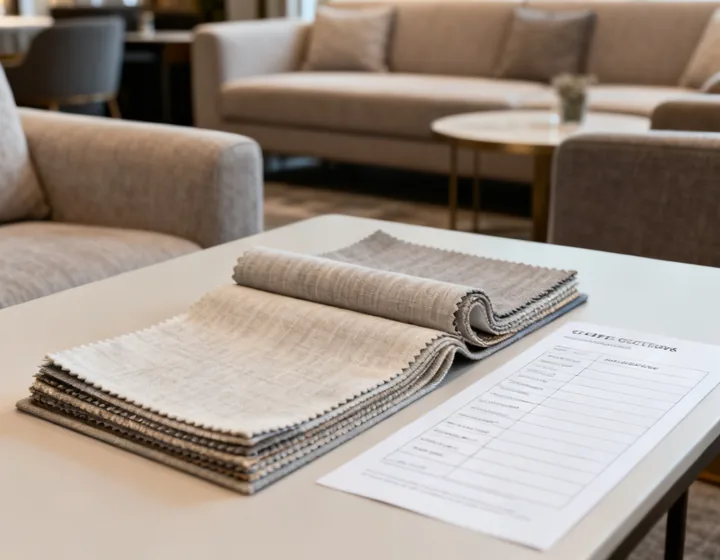
Seating programs usually need abrasion, seam slip and cleaning notes because the cloth is sat on, not only viewed. Drapery programs usually need hang, light and usable width after processing because yield changes when a coating or blackout layer is added. Contract corridors and hospitality rooms may add flame documentation; ask the proposed mill for a current document tied to the quoted article rather than a generic mill certificate. Delivery stages should name sample, first bulk lot and replenishment separately so a later dye lot is not assumed to match an earlier approval without a shade-lot rule. Site constraints such as cut length, railroad versus up-the-roll direction and panel matching belong in the brief before mills quote, otherwise installed waste is treated as a surprise rather than a specified allowance.
Residential living rooms and contract suites also differ in cleaning chemistry and occupancy hours. A family sofa that is vacuumed is not the same purchase as a hotel banquette wiped with a sanitizer. If the interior designer supplies a visual reference only, convert that image into measurable fields before mills reply: fiber content, construction, weight, usable width, finish, backing and the quantity unit that purchasing will actually order. Patterned drapery needs repeat and match direction; plain upholstery still needs a shade-lot policy because adjacent panels will be seen together. When a project ships to more than one US destination, list each city and the packing unit, because roll length that suits a workroom may not suit a jobsite cut plan. WeftMeadow Procurement uses those application notes to request mill quotes; it does not certify that a proposed cloth is suitable for a code path until the named method, edition and specimen are agreed.
Describe the interior use, documents needed and destination so quotations stay tied to the project.
Qualified business buyers may receive FREE sourcing support and up to 3% matching support after a comparable brief is reviewed. Eligibility applies to qualified business buyers and is confirmed after we review your product, quantity, destination, and sourcing requirements.
This is not a fixed discount or a time-limited offer.